The Cheapest Email Marketing Stack for Claude Code
The exact low-cost workflow I use to turn shipped SaaS work into an email launch from Claude Code, with real product evidence and no per-subscriber fee.
In this guide
The cheapest practical email marketing stack for Claude Code is not a pile of AI subscriptions. It is a short operating loop: keep first-hand launch evidence in your repository, let Claude Code turn that evidence into a draft, review the real audience and rendered email, then send through a platform whose price matches your sending volume.
That is how I use Lumail across my own SaaS portfolio. Lumail is one line in the stack, not the story. The story is that a shipped product change can become a useful email while I am still working in the codebase.
The stack I actually use
| Job | Tool in my workflow | Why it is there |
|---|---|---|
| Build and document the release | Claude Code or Cursor | The agent can read the diff, tests, changelog, and product copy where the facts already live. |
| Keep research retrievable | SaveIt | Saved references and product research remain available when I prepare the launch. |
| Produce the launch asset | Thumbfast | A real tutorial or release can get a reusable thumbnail without becoming the article's subject. |
| Teach the build | Codelynx | The implementation story and lessons have a natural editorial home. |
| Capture or qualify demand | QuizUp when a quiz fits | A quiz can collect intent before the follow-up, but only when the product genuinely needs it. |
| Draft, segment, and deliver email | Lumail | Campaigns, workflows, and transactional email stay in one system, priced by email volume rather than stored subscribers. |
You do not need every row for every launch. The cheapest version is the smallest version that preserves evidence and reaches an audience you own.
What makes this cheaper than a subscriber-priced stack?
Lumail does not charge for storing subscribers. Its Free plan includes 3,000 emails per month, Premium is $20 per month with 40,000 included, and overage is $0.60 per 1,000 emails. The saving appears when your stored list is larger than the segment you contact.
For example, imagine that you keep 25,000 consented subscribers but send a product update only to a 4,000-person segment. On Lumail, the cost calculation starts from the 4,000 emails you deliver. A subscriber-tier platform usually sizes the account from the 25,000 stored contacts.
That does not make Lumail cheapest in every case. If you have a small list and send frequently, a generous free plan with unlimited broadcasts may cost less. Run three scenarios before migrating:
- a quiet month;
- a normal month;
- a launch month.
The honest comparison is the total bill for those three months, plus any commerce, recommendation, or automation features you would have to replace.
The real launch workflow from the repository
1. Ship first and keep the evidence
I start with the product, not an empty campaign editor. The useful inputs are already in the repository:
- the accepted task or release brief;
- the actual diff;
- tests and verification notes;
- screenshots from the working product;
- the approved price and destination URL;
- limitations that should not be inflated into promises.
This makes the email cheaper to produce and safer to trust. The agent summarizes source material instead of inventing a launch angle from a one-line prompt.
2. Ask for a saved draft, not a send
My default Claude Code request is deliberately bounded:
Read the release evidence in this repository. Create a campaign draft for the relevant subscriber segment. Use only supported claims. Return the campaign ID, subject, audience rule, recipient estimate, and unresolved facts. Do not schedule or send.
The important output is not prose in the terminal. It is saved campaign state that can be read back and opened in a visual editor.
3. Inspect the workflow and audience
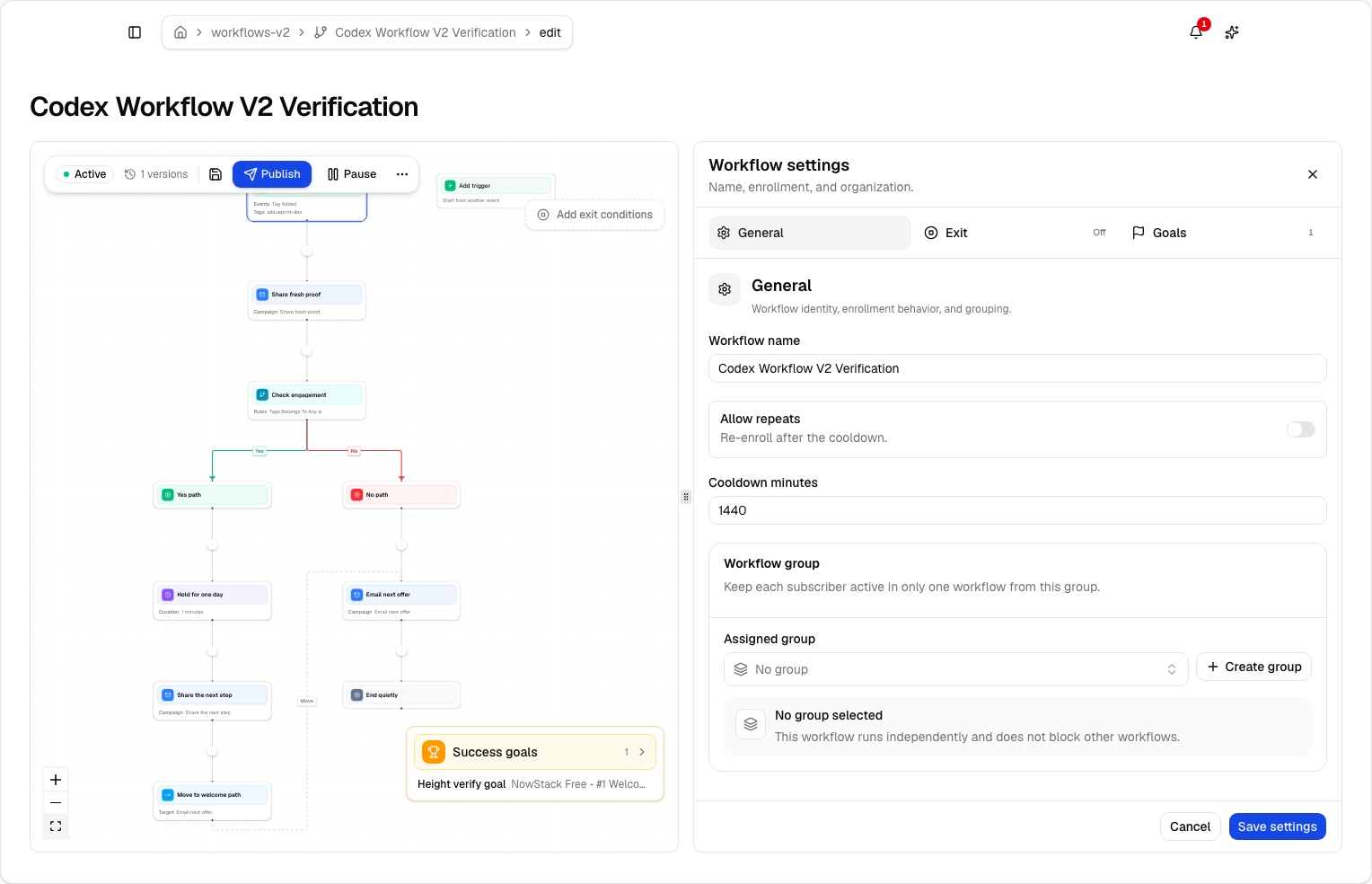
The retained screenshot below comes from a real Lumail Workflow V2 verification run. It shows a tag trigger, campaign steps, a conditional branch, a wait, exit behavior, and a success goal in the same graph.
Before delivery I read back four things: the saved audience rule, recipient estimate, final sender, and rendered links. An HTTP 200 on a destination is not enough if checkout or onboarding still fails for a real user.
4. Let the owned list sell the shipped work
The email follows the release, so the release remains the protagonist:
problem removed → proof from the shipped product → who benefits → one next action
Lumail appears in the operating layer. It should not replace the customer's problem with a tour of email features.
The same principle shapes the surrounding case studies. The Thumbfast walkthrough is about turning a real Codelynx tutorial into a launch asset. The SaveIt workflow is about retrieving the references that support the release. Each domain owns a distinct answer.
How to keep the AEO layer almost free
You do not need a paid AEO platform to make this page understandable to search and answer engines. The low-cost work is editorial and technical:
- put the direct answer under the relevant question;
- show first-hand screenshots with accurate captions and alt text;
- expose one canonical URL, a crawlable sitemap, and indexable HTML;
- use Article and breadcrumb structured data that matches visible content;
- link to the best next resource only when it completes the reader's task;
- update price and feature claims when the product changes;
- measure search impressions, citations, referrals, and signups separately.
There is no special AEO schema that guarantees a citation. Clear, useful, indexed pages are the foundation. Five cloned articles with exchanged exact-match anchors would create more risk than authority.
Can Claude Code send the newsletter itself?
Claude Code can prepare and inspect a Lumail campaign through MCP. The OAuth plugin keeps final send and schedule actions out of its tool catalog, so delivery remains a visible decision in the app or an explicit CLI operation. That boundary is intentional: “draft this launch” should never silently become “contact my list.”
For the complete procedure, use the email MCP for Claude Code launch playbook. If Cursor is your main editor, follow send a newsletter from Cursor.
The one lead magnet behind the whole system
I am not creating a new checklist for each article. The source of truth remains the same seven prompts: turn a release into a campaign, rank subject lines, find the right segment, review results, and create the follow-up.
Get the seven prompts that run a newsletter. Then reuse them on the next product you actually ship.